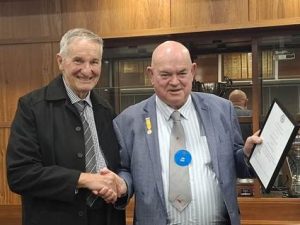
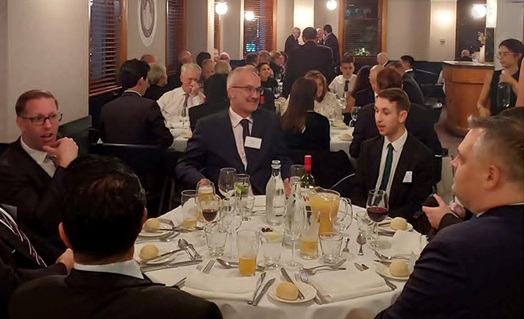
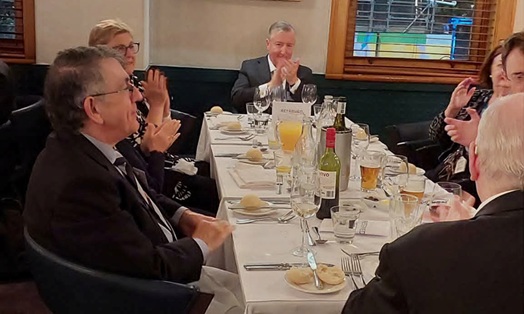
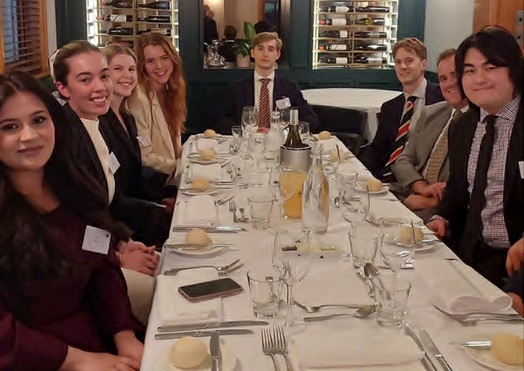
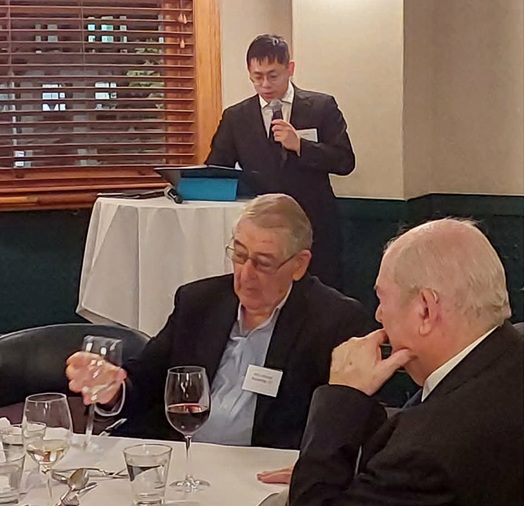
Guest speaker: Mr Justice François Kunc of the New South Wales Supreme Court
HOW CAN WE LIVE TOGETHER – PULLING TOGETHER OR COMING APART?
Introduction
May I begin by thanking the Sydney Circle of the Catenians and the St Thomas More Society for the invitation to address this year’s Law Night dinner. It is an honour to follow in the footsteps of my distinguished predecessors at this event, including last year’s speaker, my good friend and judicial colleague, the Hon Justice Michael Slattery. An evening like this is an excellent initiative by two venerable lay Catholic organisations whose contribution to Catholic life and the broader community I am very pleased to acknowledge.
Just because they are venerable does not mean that they are lacking in vitality. Quite to the contrary. The St Thomas More Society turned 80 last year. I have been a member for 40 of those years and was privileged to serve as secretary early in my legal career under its legendary President John McCarthy KC, and then his successor and former Attorney-General of NSW, the Hon Greg Smith SC. Internationally, the Catenians are a little older than the St Thomas More Society, having been founded in Manchester in 1908. However, at least according to my research, the first Catenian circle was established in Australia in 1971. What is particularly impressive is the continuing strength of both organisations when so many traditional Catholic guilds and other lay organisations have passed into history. What the two organisations have in common is their support of the Catholic laity in their professional, personal and family lives. It is a great pleasure to be with you this evening.
May I also thank Matthew Lo, the current secretary of the St Thomas More Society, for his very kind introduction. Given the topic that I wish to address this evening, it is a happy coincidence that Matthew has told you that, like many migrants and their children, I function under a common law alias. It is perfectly correct that the name I was baptised by the then chaplain to the Czech community, Fr Mika (who also married my parents), and appears on my birth certificate is František Gregory Vladimir Kunc. That fact is relevant to what follows because I want to speak to you from the perspective of a first generation Australian who, while born here, never spoke English at home, about questions of national and personal identity.
The current situation
I offer these personal reflections, and I stress they are personal, because, like many people, I think we are living through a period of particularly strong social unrest, undoubtedly amplified by the power of individuals’ access to social media. That unrest reached its horrifying zenith in the Bondi massacre, but has been roiling for years in relation to a number of hotly contested social and political issues. We are living at a time when rational and civil discourse on disputed questions seems impossible, to the point where many people of goodwill just give up and self-censor for fear of the consequences of attempting to debate what some loud voices of many different persuasions assert to be unassailable orthodoxies.
Given our current dissensions, more and more people find their way to these famous lines from WB Yeat’s solemn poem “The Second Coming”:
Things fall apart; the centre cannot hold;
Mere anarchy is loosed upon the world,
The blood-dimmed tide is loosed, and everywhere
The ceremony of innocence is drowned;
The best lack all conviction, while the worst
Are full of passionate intensity.
The poem concludes with those chilling lines, “And what rough beast, its hour come round at last, Slouches towards Bethlehem to be born?”.
Written shortly after the end of World War One, Yeats’ poem has resonated ever since as an expression of despair about the decline of established orders.
To think in terms of “the centre” and “things falling apart” is a powerful use of metaphor. Metaphor seeks to encapsulate something that we find difficult to describe with any precision. However, in doing so, it also can obscure a topic that we
need to think about with greater precision. It is with that in mind that I will develop four points:
• Unless and until the term “social cohesion” is given meaningful content, it cannot help us diagnose or resolve our current societal distress, let alone identify what, if any, new legal measures are required to protect it.
• Appeals to Australia’s multicultural tradition are misplaced in the face of dissent that has its origin in contemporary foreign disputes.
•
As Catholics we have a unique, confessional responsibility to stand in solidarity with the Jewish community and to work to end the pernicious scourge of antisemitism.
•
More generally, as Catholics we are called to advocate for and make real our belief in the dignity of the human person and the advancement of the common good, especially in the face of what is often toxic individualism.
A snapshot of Australia
In an endeavour to start with at least some precision, I will set out some facts and figures that I suggest are relevant to some of the “hot button” issues of today.
When I am overseas and am asked “what do I need to know about Australia to understand it”, the first things I draw to attention are that Australia is physically far away from the rest of the world, an island, a continent, one of the least densely populated countries in the world, and that it is innocently but invincibly culturally monolingual. Nations are moulded by their geography and their language. Despite our clustering around the capital cities, we remain a relatively small population in a huge land mass. Accepting this is a generalisation, while we are undoubtedly conscious of Indonesia and South East Asia to our north, both as individuals amongst ourselves and as a nation, we simply do not bump up on a daily basis against lots of people who are recognisably “other”. I make this point by contrast to, for example, sitting in a café in the heart of Vienna where one is likely to hear five or six different languages spoken around you and where any educated person will speak at least two, and probably more, languages. I will return to the question of language later in these remarks but I should immediately offer two reasons why it is so important.
First, it is the first indicium of the three classical elements of a nation, being a community of language (in our case English), culture (in our case still essentially
Anglo-Celtic and Anglophone) and historical experience. Second, at a personal level it quite literally shapes how we see and think about the world and people around us.
Here are some other bullet points to contemplate drawn largely from ABS statistics of the last ten years:
• As at 30 September 2025, the population of Australia was 27.7 million.
• As at June 2021, 67.2 percent of the population lived in the state and territory capital cities.
• In 2024, 31.5 percent of Australia’s resident population was born overseas; 48.2 percent had one parent born overseas and 34.4 percent had both parents born overseas.
• 21.7 percent (approximately six million) Australians speak a language other than English at home. About 820,000 self report that they speak English not well or at all.
• 3.8 percent of the population identify as Aboriginal and Torres Strait Islander, a figure of 983,700.
• 43.9 percent (11.1 million) identify as Christian; 38.9 percent (9.9 million) identify as having no religion.
• 2021’s census discloses that 3.2 percent (813,000) people identify as Muslim, a figure which has more than doubled from 2011.
• The same 2021 census discloses that those identifying as Jewish number only 117,000, that is 0.46 percent of the population. They are a minority among minorities.
• The first nationally available data in 2022 record that 4.5 percent or 910,600 people aged 16 years or older identify as LGBTIQ+, of whom 20.1 percent (183,000) identify as trans or gender diverse.
One of the things those figures reveal is that if you are Muslim, Jewish or LGBTIQ+, you definitely must rely on the counter majoritarian instinct within liberal democracy. It does appear to be generally understood that democracy is not as simple as majority rule, and that limits on majorities are integral to a true democracy. In other words, we accept that democracy combines majority rule with the protection of minority rights.
However, which minorities are protected, to what extent and how remain matters of intense political debate both here and overseas. The renewed prominence of the discussion about protection of minorities is exemplified by what, to my observation, is the decline of the use of the term “liberal democracy” in favour of “pluralistic democracy”. But to privilege the pluralistic is to risk losing sight of what are expected to be matters of general consensus, and is to envisage society as an uneasy conglomerate of distinct communities or interest groups, each clamouring for consideration. In other words, it becomes all about “me” rather than “us”. These discussions in Australia are discouraged by our famously down to earth approach to public discourse. As Justice Ian Jackman remarked in his recent Aletheia Lecture, “In Australia, we have a tradition of laconic practicality, which encourages people simply to show, not tell”. But sometimes hard thinking is needed and hard topics need to be confronted. Without intending any disrespect, it is a rare thing to hear politicians in Australia discussing, let alone debating, questions of political principles or philosophy.
I would contrast this with a French presidential debate I once watched where the two candidates framed their discussion beginning with Plato and finishing with Foucault, Habermas and Sartre. While I am not suggesting that our political life should be conducted like after dinner debates in the upper common room of an Oxbridge college, there might a useful middle position where appeals to popular preference do not completely drown out thinking about questions of principle.
Thinking about Australia as a nation I suggest that Australia has been most pithily and accurately described in an observation by Noel Pearson, someone who has thought a lot about national identity. National identity is a topic that anyone who is in the minority is more likely to think about a lot more than someone in the majority. Mr Pearson has said that Australia is three things: its ancient indigenous heritage; its formative British inheritance of a political and legal system; and the huge impact of post-war migration (which includes people like my parents, who arrived here in the late 1940s separately, with what they could carry in a suitcase and not speaking English).
Earlier this year, “Australia: A History” by former Prime Minister Tony Abbott was apparently the #1 non-fiction bestseller in Australia, with 65,000 copies reportedly sold as of early 2026. Mr Abbott picks up Noel Pearson’s point by describing Australia as “a country with an indigenous heritage, a British foundation and an immigrant character”. He suggests that “modern Australia was never a grand design. It was the spontaneous product of all those individuals and families looking to make a home or to keep one – to strike it rich”.
It does seem to me correct to say that “modern Australia was never a grand design”. Our federation was not the product of a vast social movement, a war or irresistible independence campaign. The founding fathers intended we would remain proud members of the British Empire. Federation was very much a product of a political process over at least a decade (if not, by some measures, three decades). American school children regularly learn Abraham Lincoln’s Gettysburg Address by heart. It is less than 200 words long. I doubt many Australian school children have heard of, or read, what accounts we have of Sir Henry Parke’s Tenterfield address of 24 October 1889, described as a “rousing address” given at a banquet at the Tenterfield School of Arts. The venue has been preserved and I recommend it is an interesting museum to visit if you find yourself driving to Queensland going north from Armidale. Sir Henry famously said: “surely what the Americans have done by war, Australians can bring about in peace”. However, his two arguments were hardly the stuff that would rouse a romantic patriot. He first argued that Federation would allow the creation of a single national army by bringing together the colony’s militias. His second argument was that it would enable Australia’s railway gauges to become uniform.
Nevertheless, from such pragmatic beginnings, one of the world’s most peaceful and economically successful nations has emerged. Our founders did better than they knew to adopt what is sometimes described as the “Washminster” system, a constitutional monarchy with a responsible government, namely the executive being responsible to the legislature. It has become almost commonplace to remark how different the United States of America might look today if the President was required to justify his government’s policies on a regular basis on the floor of the Congress and in the face of an official opposition led by someone perceived as the alternative President. It has become equally commonplace to observe that our almost unique compulsory voting system, when combined with a completely apolitical and independent administration of the electoral system, including as to electoral boundaries, keeps Australia safe from much of the turmoil being encountered in other countries around the world. Those features mean that we tend to cleave to the political centre.
Nevertheless, for all of these positives, I return to the fact that few would doubt that we are living through very difficult times for our society. Which brings me to my next topic.
What is social cohesion?
We have been hearing a great deal about social cohesion. We are even having a Royal Commission about it. I do not envy my friend the Honourable Virginia Bell AC and her collaborators the important task they have undertaken. I look forward to what I am confident will be their illuminating exposition of this topic. In the meantime, and without in any way wishing to pre-empt what the Royal Commission may say, when anyone talks about it, I always wonder what the speaker means by “social cohesion”. I am not suggesting that people who use it are doing so other than in good faith. However, it is another one of those difficult metaphors. It is something that it is hard to imagine anyone saying that they oppose. However what does it stand for? Is it something of which the best we can say is “I can’t describe it but I know it when I see it”?
Quite apart from my interest as a citizen, I am keen to understand the term because it is something which many people say should be protected by law, and have indeed sought to do so. If you are going to protect something by law it seems to me, with respect, that it is a very good idea to know what it is you are protecting. For example, insofar as “cohesion” means sticking together, it is unlikely that we would want laws that attempt to force people to stick together, whatever that might mean, but we might be in favour of laws which prevent activities that pull people apart, whatever that may mean. Again, we are bedevilled by metaphor.
I must acknowledge the assistance of my outstanding Tipstaff Ms Fenna Kroon, for her assistance in some of the research that has gone into these remarks. That work suggests that one of the first usages in political discourse of the term “social cohesion” was by then opposition leader Gough Whitlam QC in 1972 in his famous “It’s Time” campaign speech. While discussing social welfare, Mr Whitlam said: “We can double and treble social benefits, but we can never make up through cash payments for what we take away in mental and physical wellbeing and social cohesion through the breakdown of community life and community identity.”
Sixteen years later, John Howard sought to draw a link, that persists, between social cohesion and multiculturalism. He gave a number of speeches arguing for “social cohesion” as one of the principles which should underpin Australia’s immigration policy. In a 1988 speech at the Federation of Ethnic Communities Council he said: “It is to express that choice that this government implements, across a broad range of areas, its policies of multiculturalism. These policies celebrate our cultural diversity and harness it in the interests of individuals and of the broader community. They are policies to ensure that our diversity is accompanied by social cohesion, a fair go and a fair share for all.”
Under Kevin Rudd and Julia Gillard, talk of social cohesion was replaced by appeals to “social inclusion”. This included creating a Minister for Social Inclusion, a position that existed from 2007 to 2013. Ms Gillard was the first Minister for Social Inclusion. The features of social inclusion were
• Be well placed to secure employment.
• Know how to access needed services or how to find out.
• Understand how to seek political or community change.
• Be connected to others in life through family, friends, work, personal interests and local community.
• Consequently have some resilience when faced with personal crisis such as ill health, bereavement or loss of jobs.
With the return of Coalition governments there came a return to “social cohesion”, which is certainly now the dominant expression in speeches by politicians and other leaders of civil society. Nevertheless, neither I nor my Tipstaff has been able to find a definition in the policy of a political party, let alone in a legislative context, of what is exactly meant by “social cohesion”.
Some of you may have heard of the Scanlon-Monash Index of Social Cohesion. The Scanlon Foundation Research Institute website says it “exists as a bridge between academic insight and public thought on matters relating to Australia’s social cohesion.” I would commend that website to anyone interested in this topic. However, it does not venture a single definition of social cohesion. Rather, it seeks to identify concepts that are said to underpin it. The website acknowledges that there are “multiple, and somewhat contested, definitions of the term social cohesion. The breadth, intention and tone of the term depends heavily on whether the audience is a policy or academic community”.
Among the definitions recorded on the website are:
• “Social cohesion involves building shared values and communities of interpretation, reducing disparities in wealth and income, and generally enabling people to have a sense that they are engaged in a common enterprise, facing shared challenges, and that they are members of the same community.”
• “The willingness of members of society to cooperate with each other in order to survive and prosper”.
• “The capacity of a society to ensure the wellbeing of all its members, minimising disparities and avoiding marginalisation.”
• “A cohesive society works towards the wellbeing of its members, fights exclusion and marginalisation, creates a sense of belonging, promotes trust, and offers its members upward mobility”.
The website also makes a point important for tonight’s purposes when it says:
“Social cohesion is not synonymous with multiculturalism. While there are some parallels, multiculturalism is a civic project to bring people together and generate social cohesion.”
There can be no doubt that the Institute does rigorous and important social research. While I mean no criticism of those who use the term, it is clear that it is protean in nature and certainly difficult to identify in a way that suggests legislative protection is either possible or practical.
My final observation in relation to social cohesion is that at least in one of its manifestations it is very difficult to protect by legislation because of Australia’s implied constitutional freedom of political communication. In striking down the post-Bondi system of “public assembly restriction declarations”, the Court of Appeal in Jarrett v State of New South Wales [2026] NSWCA 62, the Court of Appeal comprising Bell CJ, Ward P and Free JA said:
This attempted justification of the law involves a particular conception of civic life and “social cohesion” that is at odds with the system of representative and responsible government for which the Constitution provides. The impugned provisions are not directed to the prevention of breaches of the peace or social disorder as conventionally understood. The purpose of the PARD scheme is not confined to protecting people in the vicinity of an assembly, or even further removed, from intimidation or the threat of violence. Instead, underpinning the State’s argument, and the logic of the legislature in passing the impugned provisions, is a notion that the community can and should be protected from political expression by some members of the community because it might be upsetting, inflammatory and divisive for other members of the community. This includes protecting people, including those physically well removed from a public assembly, from the sense of distress or offence that they may feel about an assembly occurring, and about the potential social repercussions of the assembly. “Social cohesion” is thus being used in a quite particular sense to signify a degree of calm and protection from dissent and disharmony associated with political activity of others. Where we refer in these reasons to the constitutionally illegitimate purpose of the impugned provisions, we are addressing this particular usage of “social cohesion”. Our analysis in that regard should not be understood as signifying that, as a general proposition, maintaining social cohesion is not a legitimate legislative objective.
…
The system of representative and responsible government entrenched by the Constitution, involving a free and true choice by the electors, entails acceptance of the potential for disharmony, incivility and disruption that is part and parcel of democratic intercourse. That is reflected in the longstanding recognition that the protection of dissent is at the heart of the implied freedom. It is also reflected in statements in the relevant High Court decisions about the various kinds of uncivil and objectionable behaviour that are protected by the implied freedom.
…
Recognising that the constitutionally protected system of representative and responsible government entails tolerance of a certain level of incivility and disharmony does not mean that there is no room for legitimate regulation in order to maintain standards of public order. As explained at [72] above, the pre-existing legal regime in New South Wales which provides the constitutional “baseline” against which the impugned provisions are being measured includes various offence provisions directed to such matters as violent disorder, incitement of violence and hatred and advocating force or violence against a targeted group.
Their Honours’ last observation is, with respect, instructive. It invites consideration of whether special laws to meet the current febrile circumstances are needed at all, a topic well beyond the scope of my remarks tonight. One recent example is the fact that certain individuals pleaded guilty to the charge of “offensive behaviour” where they had made disgraceful and blatant public antisemitic statements.
And what of multiculturalism?
Multiculturalism is also a very large topic. Some people in this room will be old enough to remember that it originated as a policy of the Whitlam government, spearheaded by a very colourful and controversial politician by the name of Al Grassby, who was then Minister for Immigration. However, I am hoping that tonight you will find it more interesting if I approach the question not in academic or historical terms, but rather through my own experience. That is because I am both proud and grateful that I can fairly say my own story reflects the success of something that might be called the Australian multicultural project.
Returning to Mr Abbott’s history, he writes of the migrants who, like my parents, arrived between 1945 and 1965:
“The vast majority of migrants came here not change us, but to join us. Regardless of background, nearly all of them embraced what’s been the Australian project since convict times: to enable people to better themselves and to leave their children with a better future than they had. As it’s turned out, ours is a civic rather than ethnic patriotism built on what are at least potentially universal values: personal freedom, the rule of law, democracy and a sense of a fair go…. The real assimilation came from migrant’s own desire to be part of Australia: to be accepted by their workmates, neighbours, community organisations and churches. Most importantly, their children – the dynamic link between past and future – received an Australian schooling and, over time, attended Australian universities.”
I am not here to defend the general truth or comprehensiveness of those observations. No doubt some people will disagree with them. All I can say is that they perfectly describe my own experience. In one generation my family has, through the opportunities given to us in this country, and despite my father’s early death, gone from being penniless, non-English speaking refugees (“bloody refos” was what they were called, recalling John O’Grady’s 1957 comic novel “They’re a Weird Mob”) to a Supreme Court judge married to a law firm partner of Anglo-Irish descent, and with grown, tertiary educated children who are fully integrated Australians enjoying their own successful professional careers.
Some of you may have seen a very lovely film called “Ladies in Black”. Its final scene is a luncheon party hosted by the Hungarian immigrant characters for the very Australian family with whom their lives have become intertwined. It is a whimsical and upbeat end to an endearing film. However, I had to explain to my wife, with whom I was watching the film, why I was the only person in the cinema in floods of
12
tears as the final credits rolled. The reason was because what I saw on the screen was the exact image of my childhood family dining table where my late father, who was indeed a sausage and smallgoods manufacturer, entertained our Australian friends, who quickly discovered how much they really liked weisswurst, salami, and sauerkraut served on fresh pumpernickel bread, all washed down, I have to admit, with copious quantities of Reschs Pilsener.
So it is that from my point of view, Australian multiculturalism is a process of complete assimilation or integration within often one, and definitively two, generations, linguistically and in every other respect. What we are left with, and it is by no means a bad thing, is what I call, with no disrespect intended, “folkloric” multiculturalism, where we continue to enjoy cultural and culinary celebrations from people’s places of origin. That certainly makes our country wonderfully interesting because, as my late mother often used to say, “when I arrived in this country, they didn’t even know what a cappuccino was”.
There are four other things I would like to draw to attention about multiculturalism.
First, again reflecting my own experience, it was certainly understood among the communities that I grew up in that one of the keys to making a successful life in Australia was to leave the ancient hatreds of the old country back in the old country. In the years after World War II that process was facilitated by the fact of what had been suffered by so many people, irrespective of which “side” they were on, was just so horrific that there was a very strong desire to forget. For me that was embodied by my honorary grandmother, who had come out on the boat from Europe with my mother. That lady became my mother’s closest friend. The remarkable thing was that she was a young German leaving her war-torn country and became best friends with my mother, a young Russian woman who had spent much of the war in a German prisoner of war camp.
My second point is that multiculturalism and its “leave the ancient hatreds back in the old country” rule is not able to help us to deal with the current problems in Australia where political divisions arise in response to contemporary international conflicts. Its focus was to expunge the old hatreds, not to mediate the new ones. It is, I suggest, a category error to invoke our commitment to multiculturalism as an answer to political responses to what is happening, for example, in the Middle East.
My third point is to say something about the power of language. It is the English language in the context of our civic institutions of British origin that is the driver of the project of assimilation or integration to which I have referred. There is a paradox here. It is because this country is so determinedly culturally monolingual and, in practical terms, geographically isolated, that I do not think most people appreciate the unitive force of the language.
We do not have a legislatively mandated official language in Australia. My esteemed predecessor as the General Editor of the Australian Law Journal, the Hon P W Young KC, once wrote an article exploring whether there was any legal obligation to conduct court proceedings in English. In fact, the only such legislative requirement of which I am aware is one which I have to confess I had a hand in drafting. That is to be found in the Uniform Civil Procedure Rules r 31.57 which provides “subject to this division, proceedings in the court are to be conducted in English”.
However, to demonstrate how much language matters, can I give you these three examples from other places
• Canada is officially bilingual. Some of you may have read that the CEO of Air Canada recently had to resign after a national outcry when he admitted that his French was not good enough to enable him to offer a video condolence message in French. I was similarly struck during Prime Minister Mark Carney’s recent visit to Australia that every significant speech he gave began with him asking the audience’s indulgence to deliver a summary of his remarks in French, which was undoubtedly directed at his domestic constituency.
• The current President of Ukraine is a native Russian speaker born Vladimir Zelensky. In his career as a comedian and performer, while fluent in Ukrainian, he primarily used Russian. Around the time of his presidential campaign he became Volodymyr Zelenskyy and spoke largely in Ukrainian. Now he only uses Russian publicly when addressing himself directly to the Russian people. It would be unthinkable in Ukraine for him to use Russian in any other setting.
• Compared to our Aboriginal sisters and brothers being 3 percent of the Australian population and with many (now mostly lost) languages, the Maori comprise 18 percent of the population of Aotearoa New Zealand and speak only one language. If I were a senior New Zealand judge, I would almost certainly have both begun and ended this speech with some expressions of greetings and thanks in the Maori language.
You only notice the omnipresent by its absence. Perhaps my point about language is best expressed by comparing it to air. You only notice air when there isn’t any. When one language is completely dominant, the binding power of that one language goes unnoticed because there is no alternative to compare it to.
Finally, I observe, so that at the very least it is not thought that I have overlooked it, that whatever our success has been in multicultural integration, the appalling circumstances of our Aboriginal sisters and brothers remain a stain on our national conscience and body politic. I often reflect on how can it be that a country which has been able to facilitate the advancement of so many people like me in one generation, has so singularly failed to achieve the same for those who have been here for hundreds of generations?
And what of us as Catholics?
Because I am addressing two Catholic organisations, I would like to conclude by making some brief observations about what we can do, as Catholics, in the current situation. I would like to make two points.
First, when it comes to antisemitism, quite apart from our civic obligations, I believe we have a uniquely religious obligation to decry antisemitism and stand in solidarity with our Jewish sisters and brothers. The foundational texts of the Jewish people are our foundational texts. Jesus, the apostles and the New Testament itself cannot be understood without an intimate understanding of what we call the Old Testament.
On 6 September 1938, Pope Pius XI offered a famous spontaneous reflection to a visiting group of Belgian pilgrims. He said of antisemitism:
“It is alien to us, a movement in which we Christians can have no part. The promise was made to Abraham and to his descendants… Through Christ and in Christ we are the spiritual descendants of Abraham. No, it is not possible for Christians to take part in antisemitism… Spiritually, we are semites.”
Our spiritual kinship to the Jewish people received the highest possible magisterial expression in Vatican II’s declaration Nostra Aetate. I recall with great pride being involved in the St Thomas More Society’s sponsorship of the official celebrations of the 40th anniversary of that document. It was, according to anyone I have spoken to in Rome and Israel, unique in that it was the only celebration of its kind held anywhere in the world in a synagogue, in that case the magnificent Great Synagogue in Elizabeth Street.
In terms of current issues, I respectfully suggest we must be at the forefront of asking how do we build a society that doesn’t stop with asking whether Jewish volunteer security personnel should be armed, but instead commits to building a society in which the Jewish community can walk with the same freedom as the rest of us, and do not need armed guards at schools, synagogues and public events.
My second point, and more generally, is that we must continue to proclaim in season and out the insistence of Catholic social teaching on the inherent dignity of all human beings and that each and every one of us must work for the common good, both in our individual lives and through the institutions of which we may be a part. An essential part of that proclamation is to affirm the universal right to religious liberty as the archetypal manifestation of the right to freedom of conscience. That freedom extends to not holding to any faith. Our commitment to religious liberty also received its highest magisterial expression at Vatican II in its Declaration on Religious Liberty, Dignitatis Humanae.
We must, with respect and humility, continue to advance the position that a truly democratic society must permit the expression of religious belief in the public square and not relegate it to private observance. It is not well understood that to adopt that position is not to abandon support for a society whose institutions and laws are exclusively secular. Rather, it is to contend that a truly secular society is one that does not impede the public expression of religious views and practices when they are not, solely by reason of their religious character, otherwise unlawful.
Conclusion
Earlier in these remarks I talked about metaphor. I would like to leave you with an image which, at least to me, says something about our circumstances as Catholic Christians in today’s world.
Not long after the Russian invasion of Ukraine, I purchased from an art gallery in Lviv in Western Ukraine a traditional icon of the Nativity. In the classical style of Eastern Orthodoxy, the icon writer shows the Christ child being kept warm by the breath of the ox and the ass, with Mary and Joseph standing on either side of the manger. It speaks of the breaking forth of the divine into our troubled world. It is a powerful image. But its true power only becomes apparent when you pick up the icon and turn it over. Then you will see that it has been written on the lid of an ammunition box. For me, it symbolises that in the midst of war and suffering, including the suffering of those touched by the events at Bondi, the enduring presence of the Prince of Peace abides. We believe that we are sent into the world as missionaries to continue to proclaim Christ’s message of love. While we can do so with words, we are probably at our most effective when we do so as individuals, one to one, in our smallest and simplest daily encounters.
Every such encounter takes us one step closer to the kingdom we are called upon to make present in our world. That kingdom, in the beautiful words of the preface for the Feast of Christ the King is a “kingdom of truth and life, a kingdom of holiness and grace, a kingdom of justice, love, and peace.”
It has been a great privilege for me to be able to address members of two Catholic organisations each of which, in its own way, is committed to that mission. Whatever is to be done at the level of law, politics and public policy, we have our individual responsibility to address the challenges to which I have referred as Catholic Christians. Let us work together, and with all our fellow citizens of good will, to fulfill that responsibility.